FOR loop
Good Morning students
Today we will look at the comparison between WHILE and FOR loops and see how the FOR loop works.
-----------------------------------------------------------------------------------------
The Google meet link for today's class is :
------------------------------------------------------------------------------------------------------------
By the end of today's session, you will be able to:
- Differentiate between CONDITIONAL and COUNTING Loops.
- Understand the working of the FOR loop
- Apply the knowledge to create appropriate FOR loops to give the desired results.
CONDITIONAL LOOP:
- The loops that repeat until a certain thing happens
- They keep repeating as long as some condition is true.
- Therefore, we can say that WHILE loop is conditional loop
- We cant say in advance, how many times this loop will execute.
COUNTING LOOPS:
- The loops that repeat a certain number of times
- it is designed to process the items of any sequence, such as a list or string , one by one
- FOR loop is a counting loop
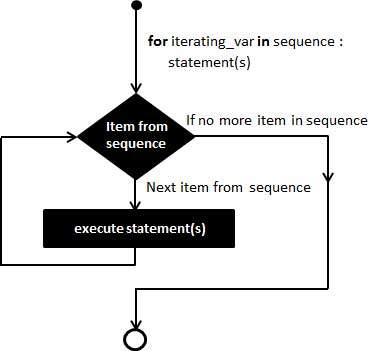
The general form of FOR LOOP is as given below:
for variable in sequence :
statements_to_repeat
Syntax
for iterating_var in sequence:
   statements(s)
If a sequence contains an expression list, it is evaluated first.
Then, the first item in the sequence is assigned to the iterating variable iterating_var.
Next, the statements block is executed.
Each item in the list is assigned to iterating_var, and the statement(s) block is executed until the entire sequence is exhausted.
Flow Diagram
For example, consider the following loop:
for a in [1,4,7]:
print(a)
print(a*a)
In the above example, variable a will be assigned each value of list one by one,
- for the first time a will be 1
- then a will become 4
- and finally a will become 7
- The body of the loop is showing in the pink colour.
- All statements in the body of the loop will be executed for each value of loop variable a
- i.e. for a=1 , then for a=4 then for a=7
------------------------------------------------------------------------------------------
A loop in Python is processed as
- The loop-variable is assigned the first value in the sequence
- All the statements in the body of the FOR loop are executed with assigned value of loop variable (STEP 2)
- Once STEP 2 is over, the loop variable is assigned the next value in the sequence and the loop-body is executed(i.e. STEP 2 repeated) with the new value of loop-variable
- This continues until all values in the sequences are processed.
- It has the ability to iterate over the items of any sequence, such as a list or a string.
Example
#!/usr/bin/python

for letter in 'Python':     # First Example
   print 'Current Letter :', letter

fruits = ['banana', 'apple',  'mango']
for fruit in fruits:        # Second Example
   print 'Current fruit :', fruit

print "Good bye!"
When the above code is executed, it produces the following result −
Current Letter : P
Current Letter : y
Current Letter : t
Current Letter : h
Current Letter : o
Current Letter : n
Current fruit : banana
Current fruit : apple
Current fruit : mango
Good bye!


Good morning mam
ReplyDeleteGood morning ma'am
ReplyDeleteBrian
Good morning mam
ReplyDeleteSahil
Good morning ma'am
ReplyDeleteAryan francis
X-A